The apparent BGP4 square law relationships... and their demise
This is about the observation that, over many years, the size of the BGP4 routing table appeared to grow approximately in proportion to the square root of the size of the globally addressable Internet. Publications about this are described below. But first...
2025 update
It is no longer possible to make a consistent estimate of the total number of IPv4 and IPv6 hosts, as was done for the two publications mentioned below. Thus, it is no longer possible to track the square law relationships. However, the other interesting relationship - between the number of active BGP4 routes and the number of active Autonomous Systems - can still be tracked, thanks to Geoff Huston and potaroo.net. Thus, here are the two graphs, with data until mid-July 2025. (There's nothing magic about July; it's simply when the first data for the original paper was gathered.) Note that there are no dates on these graphs: although the data points were measured annually, the graphs show how the topology scaled, not when it scaled.
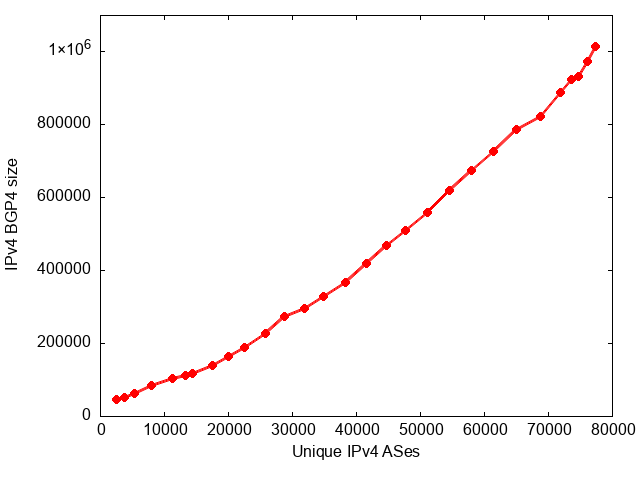
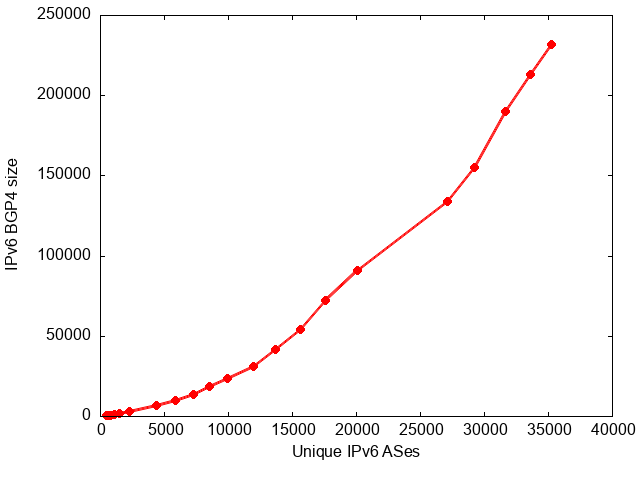
What you can see here is that IPv4 routing continues to scale as it has done for many years. However, there is an apparent tendency for the number of IPv6 routes to increase faster than the number of autonomous systems. If we plot the two curves together (remembering that the IPv4 history started in 1994, and the IPv6 history in 2004), we can directly compare what happened:
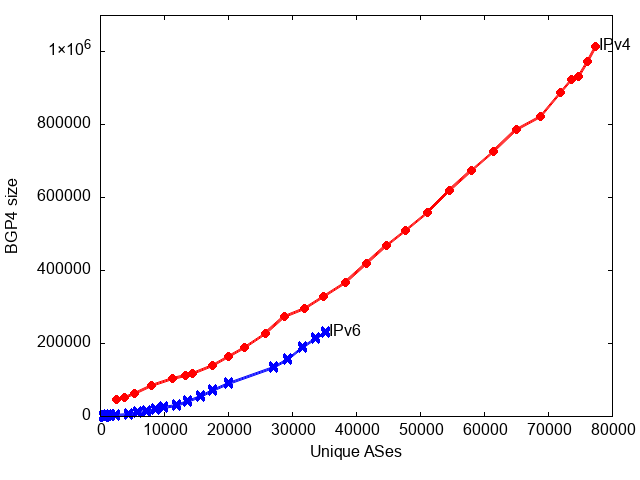
It seems that topologically, IPv6 routing is looking very much like IPv4 at a similar stage in its evolution. The gap between the two curves can be attributed to IPv4's "toxic waste" - the un-aggregated routes that still survive from before CIDR was introduced.
Most recent publication
A square law revisited,
ACM SIGCOMM CCR, 51(3) (July 2021) 41-45
Abstract:
An earlier study observed that until 2008, the size of the BGP4 system for IPv4 appeared
to have grown approximately in proportion to the square root of the host count of
the globally addressable Internet. This article revisits this study by including IPv4
data until 2020 and adding IPv6 data. The results indicate that BGP4 for IPv4 is continuing
to scale steadily even as IPv4 approaches its end of life, and that it is working
as it should for IPv6, except for a slight concern that the number of announced routes
is trending upwards faster as time goes on.
Original publication
Observed Relationships between Size Measures of the Internet,
ACM SIGCOMM CCR, 39(2) (April 2009) 6-12
Abstract:
This paper reports some observations on the relationships
between three measures of the size of the Internet over more
than ten years. The size of the BGP4 routing table, the
number of active BGP4 Autonomous Systems, and a lower
bound on the total size of the Internet, appear to have fairly
simple relationships despite the Internet's growth by two orders
of magnitude. In particular, it is observed that the size
of the BGP4 system appears to have grown approximately in
proportion to the square root of the lower-bound size of the
globally addressable Internet. A simple model that partially
explains this square law is described. It is not suggested that
this observation and model have predictive value, since they
cannot predict qualitative changes in the Internet topology.
However, they do offer a new way to understand and monitor
the scaling of the BGP4 system.
Note that the observations concern IPv4 only. ISC domain count data are used as lower
bounds on the total size of the IPv4-addressable Internet. The choice and validity
of this metric are discussed in the paper.
Errata:
- The authors of references [15] and [16] have been swapped.
- The parenthesis next to Fig. 3 "(or more
accurately, about 8 entries above a baseline of about 18000)" should end "...about 15000)".
Cited in:
- Boguna, M. et al., Sustaining the Internet with hyperbolic
mapping, Nature Communications 1:62 (2010).
- L. Cittadini, W. Muhlbauer, S. Uhlig, R. Bush, P. Francois and O. Maennel,
Evolution of Internet Address Space Deaggregation: Myths and Reality,
IEEE Journal on Selected Areas in Communication (JSAC),
August 2010.
External talks on this topic
BGP scaling revisited,
(IEPG Meeting, Taipei, China, November 2011)
BGP growth over 15 years,
or Is the Internet really just a star network after all?
(Keynote at APRICOT 2010, March 2010)
Observed Relationships between Size Measures of the Internet,
or Is the Internet really just a star network after all?
(Seminar, University of Cambridge, June 2009)
Some multi-year graphs (IEPG Meeting, Dublin, Ireland, July 2008)
Page updated 2026-05-19.
Home page
Disclaimer