Peter Kulka - High Resolution splatting
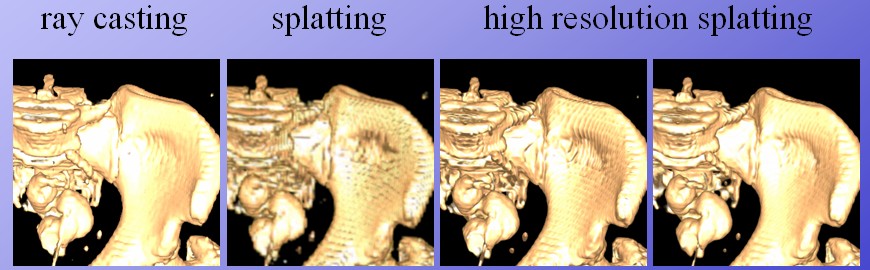
Volume rendering is a research area where images are computed from volumetric data sets for visual exploration. The technique is especially popular in biomedical imaging where where volumetric data sets are generated by Compouter aided Tomography (CT), Magnetic Resonance Imaging (MR), Positron Emission Tomography (PET) and many other imaging modalities. The two principal techniques used for volume rendering are ray casting where rays are shot from the view plane into the volume and splatting where the volume data set is traversed and each volume element is projected onto the view plane. Peter Kulka under supervision of Richard Lobb has developed two new splatting methods that correct erros of the standard splatting method while being significantly faster than the ray casting method. In addition an extended splatting method is presented that can be used to visualize wavelet transformed volume data sets without performing an inverse transform.
Parker Shaw - 3D Reconstruction of Piscine Vision
Parker Shaw under supervision of Richard Lobb has modelled and visualised the visual acuity volume of the Common Smelt. The visual acuity of the fish is determined by the mosaic of photoreceptors on the retina and the magnifying factor of the lens. The raw data set consists of a series of photographs of frozen slices of Smelt head and two photoreceptor density maps of a Smelt left retina. The authors use the photos of frozen slices to determine the geometric parameters of the fish visual system, such as size and orientation of the eyeball, location of the lens within the eyeball and the spatial relation between the two eyeballs. The photoreceptor density map determines the visual acuity scalar field outside the fish body and is visualized by drawing iso-surfaces.
Grant
Ng - Fitting Surfaces to Multiple Orthogonal Contour Sets