
Dr Paul Denny
Professor
School of Computer Science
The University of Auckland
New Zealand

Dr. Paul Denny is a Professor in Computer Science at the University of Auckland, New Zealand. His research
interests include developing and evaluating tools for supporting collaborative learning, particularly involving
student-generated resources, and exploring the ways that students engage with these environments. His recent work in computing education has explored the implications arising from the emergence of large language models such as Codex. One of his projects,
PeerWise, hosts more than six million practice questions, with associated solutions and explanations, created by
students from 90 countries. He has fostered a community of educational researchers around this project, more than
160 of whom have published their work as a result. Dr Denny has been recognized for contributions to teaching both
nationally and internationally, receiving New Zealand's National Tertiary Teaching Excellence Award (2009), the
Computing Research and Education Association of Australasia Award for Outstanding Contributions to Teaching (2010),
and the QS Reimagine Education Overall Award (2018).
Recent work
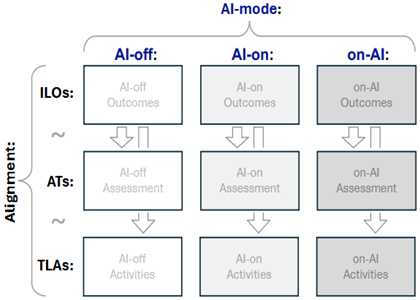
Constructive alignment
How Constructive Alignment remains relevant in the age of AI.
Read more...BibTeX
@misc{brabrand2026constructive,
  title     = {Constructive Alignment in the Age of AI},
  url       = {https://osf.io/preprints/edarxiv/m9yfk_v2},
  doi       = {10.35542/osf.io/m9yfk_v2},
  publisher = {EdArXiv},
  author    = {Brabrand, Claus and Denny, Paul},
  year      = {2026},
  month     = jul
}
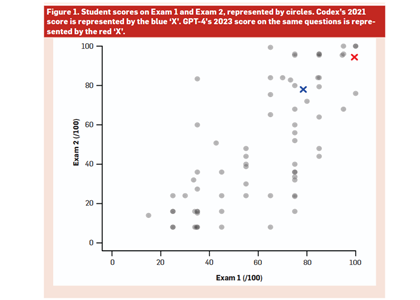
Computing and Gen AI
The educational opportunities and challenges of Gen AI
Read more...BibTeX
@article{denny2024computing,
  author       = {Denny, Paul and Prather, James and Becker, Brett A. and Finnie-Ansley, James and Hellas, Arto and Leinonen, Juho and Luxton-Reilly, Andrew and Reeves, Brent N. and Santos, Eddie Antonio and Sarsa, Sami},
  title        = {Computing Education in the Era of Generative AI},
  year         = {2024},
  issue_date   = {February 2024},
  publisher    = {Association for Computing Machinery},
  address      = {New York, NY, USA},
  volume       = {67},
  number       = {2},
  issn         = {0001-0782},
  url          = {https://doi.org/10.1145/3624720},
  doi          = {10.1145/3624720},
  journal      = {Commun. ACM},
  month        = jan,
  pages        = {56--67},
  numpages     = {12}
}
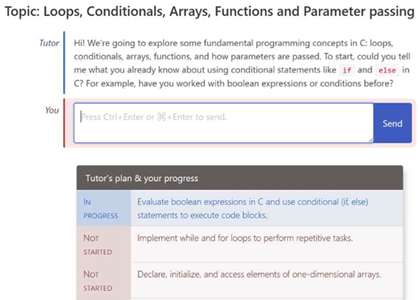
Building AI Companions
And ensuring they prioritise learning over short-term performance.
Read more...BibTeX
@article{khosravi2026building,
  title    = {Building AI companions that prioritise learning over performance},
  journal  = {Computers and Education: Artificial Intelligence},
  volume   = {11},
  pages    = {100680},
  year     = {2026},
  issn     = {2666-920X},
  doi      = {10.1016/j.caeai.2026.100680},
  url      = {https://www.sciencedirect.com/science/article/pii/S2666920X26001426},
  author   = {Hassan Khosravi and Dragan Gaševic and Shazia Sadiq and Lixiang Yan and Jason M. Lodge and Jason M. Tangen and Paul Denny and Kristen DiCerbo and Simon {Buckingham Shum} and Ryan S. Baker},
  keywords = {Generative AI, AI in education, Adaptive learning, Learning companions}
}
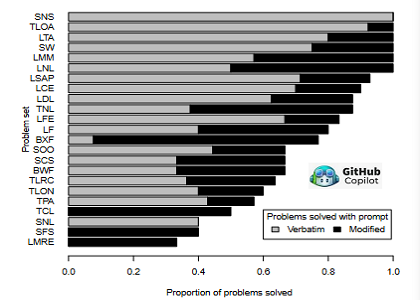
Conversing with Copilot
Considering natural language interactions for solving coding tasks.
Read more...BibTeX
@inproceedings{denny2023conversing,
  author       = {Denny, Paul and Kumar, Viraj and Giacaman, Nasser},
  title        = {Conversing with Copilot: Exploring Prompt Engineering for Solving CS1 Problems Using Natural Language},
  year         = {2023},
  isbn         = {9781450394314},
  publisher    = {Association for Computing Machinery},
  address      = {New York, NY, USA},
  url          = {https://doi.org/10.1145/3545945.3569823},
  doi          = {10.1145/3545945.3569823},
  booktitle    = {Proceedings of the 54th ACM Technical Symposium on Computer Science Education V. 1},
  pages        = {1136--1142},
  numpages     = {7},
  keywords     = {artificial intelligence, cs1, foundation models, github copilot, introductory programming, large language models, openai},
  location     = {Toronto ON, Canada},
  series       = {SIGCSE 2023}
}